

Poker and Baccarat Tips for Exploring Table Variety Key Takeaways
Casino players who limit themselves to one variant of poker or baccarat miss out on profitable opportunities.
- Poker and Baccarat Tips for Exploring Table Variety start with knowing the key differences between Texas Hold’em vs. Omaha and Punto Banco vs. Chemin de Fer.
- Smart table selection balances your bankroll, skill level, and the pace of play you prefer.
- Transitions between poker and baccarat become smoother when you focus on positional awareness and bankroll discipline in both games.
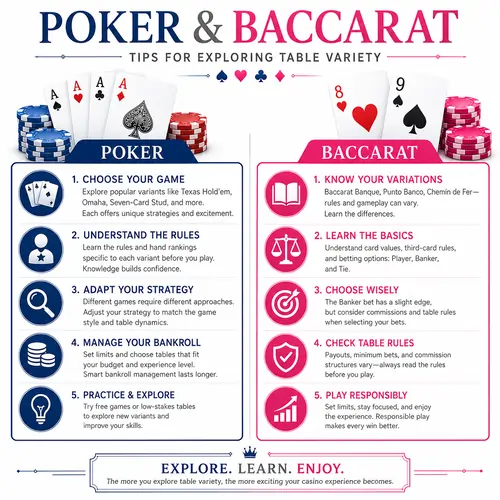
Why Understanding Poker and Baccarat Table Variety Matters
Casino players who limit themselves to one variant of poker or baccarat miss out on profitable opportunities. The same player who excels at Texas Hold’em may struggle in Omaha, and a seasoned Punto Banco player might find Chemin de Fer confusing. Poker and Baccarat Tips for Exploring Table Variety help you identify which tables suit your current skill set and budget. By expanding your repertoire, you become a more adaptable and confident player across different casino environments. For a related guide, see Poker and Baccarat Review of Popular Casino Variants.
Table variety also affects the house edge, betting options, and social dynamics. For example, the pace of play in speed baccarat is much faster than in traditional Chemin de Fer, which can impact decision-making and bankroll management. Knowing these nuances before sitting down turns a guessing game into a calculated choice.
Comparing Poker Table Types: Texas Hold’em vs. Omaha
The most common poker variants offered in casinos are Texas Hold’em and Omaha. While both share the same basic hand rankings, the differences in starting hands and betting structure require entirely different strategies.
Texas Hold’em: The Standard for Poker Table Selection
Texas Hold’em is the default choice for many players because of its straightforward rules and deep strategic layers. With four betting rounds and only two hole cards, the game emphasizes reading opponents and making calculated bluffs. Poker table selection in Texas Hold’em often depends on table image and stack size. A tight-aggressive player might look for loose passive tables where they can profit from value bets.
Key factors when choosing a Texas Hold’em table include the average stack depth, the number of players per flop, and the aggression level of regulars. Avoid tables where you are the shortest stack unless you plan to play a short-stack strategy. For beginners, low-limit tables with less aggression provide room to learn positional play without risking large sums.
Omaha: High Variance and Broad Strategy
Omaha, especially Pot-Limit Omaha (PLO), rewards players who understand hand connectivity and equity distribution. With four hole cards instead of two, the number of possible combinations increases dramatically. Poker table selection for Omaha should prioritize tables with fewer players (6-max instead of full ring) to reduce complexity and maximize hand frequency.
Be aware that Omaha games tend to have higher variance. A player who usually grinds low-stakes Hold’em may find the swings unsettling. Look for tables where opponents play too many hands or overvalue weak draws. Avoid tables with experienced Omaha regulars who understand wrap draws and blocker effects. Bankroll management becomes critical here — keep at least 50 buy-ins for the limit you choose.
Exploring Baccarat Table Variety: Punto Banco, Chemin de Fer, and Speed Baccarat
Baccarat is often perceived as a single game, but several variants exist, each with its own rule set and player involvement. Understanding baccarat table variety helps you pick the version that matches your comfort with decision-making and pace.
Punto Banco: The Most Common Version
Punto Banco is the standard baccarat found in most casinos. The house directs the game, and players have no decisions beyond choosing to bet on Player, Banker, or Tie. This version is ideal for players who prefer a purely chance-based experience with no skill component. Baccarat table variety in Punto Banco mostly involves minimum bet limits and the number of decks used. Lower-limit tables (e.g., $10–$25) attract a social crowd, while high-limit rooms offer stricter rules and fewer distractions.
Because Punto Banco doesn’t require any strategic choices, players can focus entirely on bankroll management and bet sizing. Many experienced players use a flat betting approach to minimize risk over long sessions. If you are new to baccarat, start with Punto Banco and learn the pace before trying more interactive versions.
Chemin de Fer: Interactive and Higher Skill
Chemin de Fer is the original European baccarat where players take turns acting as the banker. This version involves real decision-making — the banker decides whether to draw a third card based on the totals. Baccarat table variety here is about finding a table where the acting banker is less experienced, giving the other players a slight edge through pattern recognition.
The social element in Chemin de Fer is stronger because players can influence the outcome. However, the game moves slower than Punto Banco. If you prefer a strategic challenge and enjoy interacting with other players, Chemin de Fer offers a richer experience. Be prepared for higher minimum bets in this variant because it draws more seasoned players.
Speed Baccarat and Mini-Baccarat
Speed Baccarat reduces the time between rounds significantly, often completing 70–80 hands per hour. This version suits players who want fast action and don’t mind a high-powered environment. Mini-baccarat uses the same rules as Punto Banco but is played on a smaller table with lower limits. It is an excellent entry point for beginners exploring baccarat table variety without committing to high stakes.
Smart Strategies for Casino Game Variety Tips
Moving between poker and baccarat tables requires a shift in mindset. The same principles of bankroll management and emotional control apply, but the skill curves differ greatly. Here are actionable casino game variety tips to help you transition smoothly. For a related guide, see FC Slots Tips for Exploring Action Inspired Releases.
1. Match Table Limits to Your Bankroll
Before sitting at any poker or baccarat table, calculate your session budget and divide it into 50 to 100 betting units. For poker, that means 50 buy-ins for No-Limit Hold’em and 100 buy-ins for Pot-Limit Omaha. For baccarat, allocate units equal to about 1% of your total bankroll per hand. This approach keeps you in the game longer and reduces the risk of ruin.
2. Observe Before You Play
Spend at least 10 minutes observing any new table variant before joining. Watch how players bet, how often the action is aggressive, and whether the dealer maintains a consistent pace. This practice is especially useful when exploring baccarat table variety because different casinos may have subtle rule variations, such as whether the Banker draws on a 3 when the Player’s third card is a 9.
3. Adjust Your Strategy for Game Variance
Poker has high variance due to player decisions and luck, while baccarat has fixed probabilities that eliminate skill variance. When switching from poker to baccarat, shift your focus from reading opponents to managing bet progression. Conversely, when moving from baccarat to poker, remember that you must outplay others, not just the odds. Casino game variety tips emphasize that flexibility is the key to long-term success.
Common Mistakes When Exploring Table Variety
Many casino players jump into a new table type without researching the specific rules or bankroll requirements. This leads to uncomfortable situations where they feel out of place or lose funds quickly.
Underestimating the Learning Curve
Going from Texas Hold’em to Omaha without studying starting hand selection is a common error. The first few sessions may lead to heavy losses. Similarly, a player used to Punto Banco might find Chemin de Fer frustrating because they must make decisions that affect the outcome. Allocate a learning bankroll for each new variant — money you are willing to lose while gaining experience.
Choosing the Wrong Table for Your Skill Level
If you are a beginner in Omaha, avoid tables with high average pot sizes and aggressive players. For baccarat, avoid high-limit rooms until you are comfortable with the pace and betting structure. Poker and Baccarat Tips for Exploring Table Variety remind you that table selection is a skill in itself — always pick the table where you have the highest expected value, not the highest glamour.
Ignoring Bankroll Discipline When Switching Games
After a winning poker session, players sometimes move to a baccarat table and bet larger units than planned. This emotional spillover erodes previous profits. Treat each game session independently. Reset your bankroll mindset before walking to a different table type.
Useful Resources
For deeper dives into poker and baccarat strategies, explore these authoritative guides:
- PokerStrategy.com: Strategy Articles and Hand Analysis – Comprehensive strategy content covering Texas Hold’em, Omaha, and bankroll management tips.
- Wizard of Odds: Baccarat Rules and House Edge – Detailed breakdown of baccarat variants, odds, and betting systems from a respected math-based source.
Frequently Asked Questions About Poker and Baccarat Tips for Exploring Table Variety
What is the best table type for beginners in poker?
Texas Hold’em at low-limit tables is ideal for beginners because the rules are straightforward, and you only have two hole cards to manage. Look for tables with fewer aggressive players to practice fundamental strategy.
How do I choose between Punto Banco and Chemin de Fer?
If you prefer a simple, fast game with no decision-making, choose Punto Banco. If you want a slower, more interactive experience where you can act as banker and influence the outcome, try Chemin de Fer.
What is the difference between Texas Hold’em and Omaha in terms of strategy?
In Texas Hold’em, hand reading and bluffing are central. In Omaha, the focus shifts to drawing potential and equity calculations because players start with four cards. Omaha tends to have larger pots and higher variance.
Is speed baccarat harder to play?
Speed baccarat is not harder in terms of rules, but the fast pace can pressure you into making quicker bet decisions. It may be challenging for players who like to take their time.
How many buy-ins should I have for Omaha?
For Pot-Limit Omaha, a minimum of 100 buy-ins is recommended due to the higher variance compared to Texas Hold’em. This protects your bankroll during downswings.
Can I use the same bankroll for poker and baccarat?
It is better to keep separate bankrolls for poker and baccarat because the risk profiles differ. Poker relies on skill, while baccarat is pure chance. Mixing them can lead to poor money management.
What is the house edge in Punto Banco?
The house edge on the Banker bet is approximately 1.06%, on the Player bet 1.24%, and on the Tie bet over 14%. The Banker bet offers the best odds.
Is Chemin de Fer better odds than Punto Banco?
Chemin de Fer can have a slightly lower house edge if the banker makes optimal drawing decisions, but it requires skill. In practice, many casual players give back that edge through suboptimal plays.
How do I find loose passive poker tables?
Observe tables before joining. Loose passive tables have many players seeing the flop but few aggressive raises. Casino poker rooms often list average pot size and players per flop on screens.
What is the minimum bet for Chemin de Fer?
Minimum bets are typically higher than Punto Banco, often starting at $25 to $100. Because the game attracts experienced players, limits tend to be elevated.
Should I always bet on Banker in baccarat?
Statistically, the Banker bet has the lowest house edge, but it also requires a 5% commission on wins. Betting exclusively on Banker is a solid default strategy for long-term play.
How long should I observe a table before sitting down?
At least 10–15 minutes is recommended. Watch for betting patterns, number of players, and general aggression. In baccarat, also observe how many decks are used and whether the casino allows mid-shoe entry.
Is Omaha easier to win than Texas Hold’em?
Omaha is not easier — it has a steeper learning curve and higher variance. However, if you become proficient, the softer games at some casinos can be profitable because many players overvalue weak hands.
What are the key differences between mini-baccarat and standard baccarat?
Mini-baccarat has lower minimum bets, a smaller table, and is faster because the dealer handles all cards. Standard baccarat may have a larger table and more ceremony, especially in high-limit areas.
Can I use poker reads in baccarat?
No. Baccarat outcomes are independent of player decisions (except in Chemin de Fer). Poker reads have no application in Punto Banco or speed baccarat. Adjust your mindset accordingly when switching games.
How does table size affect my poker strategy?
Full-ring tables (9–10 players) require tighter starting hands and more positional awareness. Short-handed tables (6 players) demand a wider range and more aggressive play. Choose the size that matches your comfort zone.
Is there a best time to play certain baccarat variants?
Weekend nights often have more players and higher limits, which can create a more social atmosphere. For quieter, lower-stakes sessions, weekday mornings may be better. The game odds remain the same regardless of time.
What is the biggest mistake beginners make in Omaha?
Playing too many hands. In Omaha, average hand strength is higher, so beginners should play only premium starting hands and avoid chasing weak draws. Tight preflop play is the first step to success.
Can I bluff effectively in baccarat?
No. Baccarat is a game of pure probability with no bluffing element. Any attempt to bluff is meaningless because players do not compete against each other — they bet on which hand will win.
How do I transition between poker and baccarat without losing focus?
Take a short break between sessions. Clear your mind of poker strategies before sitting at a baccarat table. Reset your bankroll and mentally prepare for a game where skill plays no part in the outcome.