

Poker and Baccarat Tips for Developing Table Skills Key Takeaways
Mastering the felt requires more than luck—it demands Poker and Baccarat Tips for Developing Table Skills that sharpen your decision-making, bankroll management, and reading of opponents.
- Focus on position and hand selection in poker; understand the banker-bet advantage in baccarat.
- Manage your bankroll with session limits to avoid tilt and emotional decisions.
- Practice disciplined observation at the table to identify patterns and player tendencies.
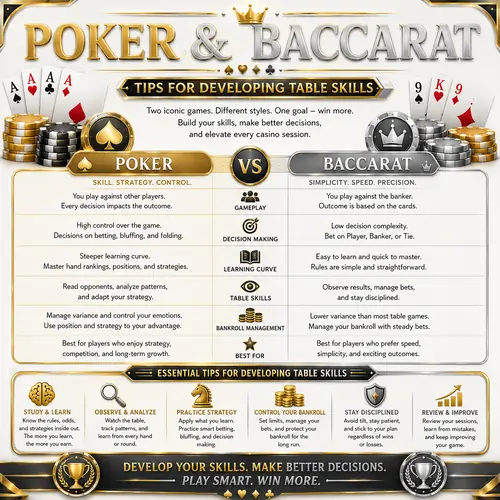
Why Poker and Baccarat Tips for Developing Table Skills Elevate Your Casino Experience
Walking into a casino without a plan is like sailing without a compass. Poker and Baccarat Tips for Developing Table Skills give you a structured approach to both games, so you play with intention rather than impulse. While poker rewards reading opponents and calculating odds, baccarat emphasizes pattern recognition and disciplined betting. The common thread? Table skills built on preparation, observation, and emotional control. For a related guide, see Poker and Baccarat Tips for Building Playing Skills.
In this guide, we break down proven strategies for each game, highlight common pitfalls, and answer the questions most players ask. Whether you are a beginner or a seasoned player looking to refine your approach, these tips will help you sit down with greater confidence.
Poker Strategies: Build a Solid Foundation
Poker is a game of incomplete information where every decision carries weight. The following Poker and Baccarat Tips for Developing Table Skills focus specifically on poker to help you think like a pro.
1. Master Position and Starting Hands
Your position at the table determines how much information you have before acting. In late position (button or cutoff), you can play a wider range of starting hands because you see how opponents bet before you. In early position, tighten your range—fold mediocre hands like K-10 offsuit or small suited connectors and wait for premium pairs or high suited connectors. Good hand selection prevents costly mistakes before the flop even arrives.
2. Observe Your Opponents
Pay attention to betting patterns, timing, and physical tells. Does a player bet fast when strong? Do they check-raise only with top pairs? Taking mental notes over several orbits helps you categorize opponents as tight, loose, aggressive, or passive. Adjust your own strategy accordingly: against tight players, steal blinds more often; against loose players, value-bet your strong hands relentlessly.
3. Manage Your Bankroll with Session Limits
One of the most overlooked casino game strategies is setting a stop-loss and a win goal before you sit down. Decide how much you are willing to lose in a session (typically no more than 5% of your total bankroll) and leave if you hit that number. Similarly, if you double your buy-in, consider locking in profits and playing tighter or calling it a night. Emotional control prevents chasing losses and preserves your ability to play another day.
4. Learn to Fold—Even When You Are Invested
Many players struggle to fold after putting money into the pot. But stubbornness is a leak. If the board shows a flush or straight possibility and your opponent is betting aggressively, trust the odds. Folding a hand that has equity but is likely behind saves chips over the long run. Remember: every chip saved is a chip earned.
5. Practice Pot Odds and Expected Value
Basic math separates winning players from those who guess. Know how to calculate pot odds (the ratio of the current pot size to the cost of a call) and compare them to the odds of completing your draw. If the pot odds are better than the drawing odds, calling has positive expected value. Using poker odds apps or charts during practice sessions builds this skill until it becomes instinctive.
6. Vary Your Play to Stay Unpredictable
If you always bet big with strong hands and check with weak ones, observant players will exploit you. Mix in occasional bluffs, slow-play strong holdings on dry boards, and raise from different positions. Predictability is a weakness; controlled aggression with a balanced range keeps opponents guessing and increases your win rate.
Baccarat Tips: Simplicity Meets Discipline
Baccarat may look like a game of pure chance, but smart players use Baccarat tips to tilt the odds in their favor. These Poker and Baccarat Tips for Developing Table Skills apply specifically to baccarat’s unique flow.
1. Always Bet on the Banker
The banker bet has the lowest house edge in baccarat—around 1.06% compared to 1.24% for the player bet. Over hundreds of hands, that small difference compounds. Even after the 5% commission on banker wins, it remains the mathematically superior choice. Avoid the tie bet entirely; its house edge exceeds 14%, making it a sucker’s wager.
2. Stick to a Betting System—But Keep It Simple
Systems like the 1-3-2-6 or the Martingale can add structure to your session, but they do not change the odds. Use a flat-betting approach for consistency: wager a fixed unit size (e.g., 1% of your bankroll) on every hand. If you want to try a progression, set a strict loss limit and never chase a losing streak. The goal is to extend play while minimizing risk.
3. Track Streaks Without Overvaluing Them
Many baccarat players keep scorecards to note whether the banker or player won the last few hands. While patterns exist in retrospect, each hand is independent of the last. Use the scorecard to inform your bet selection, but do not alter your bet size based on a perceived streak. Disciplined players follow the math, not superstition.
4. Avoid the Tie Side Bet
As tempting as the 8:1 or 9:1 payout looks on the tie bet, the house edge is crushing. Developing table skills means recognizing when a bet is financially unsound. The tie bet occurs only about 9.5% of the time; that 14%+ house edge means you lose money faster. Stick to banker or player and let the math work for you.
5. Set Win and Loss Limits Before You Play
Just like poker, decide how much you are willing to lose (e.g., €200) and a realistic win goal (e.g., €100). Once you hit either limit, walk away. This discipline prevents you from giving back winnings or digging deeper into a losing session. Use a separate pocket or digital wallet to keep your session bankroll distinct from your cash.
6. Practice Free Online Versions First
Before risking real money, play baccarat for free on reputable online casinos. This helps you internalize the dealing rules, practice your betting approach, and test how you react to swings without financial pressure. Casino game strategies improve faster when you can experiment without consequences. For a related guide, see Poker and Baccarat Tips for Understanding Game Rules.
Common Mistakes to Avoid at the Table
Even experienced players fall into traps that cost them money. Here are three frequent errors and how Poker and Baccarat Tips for Developing Table Skills help you avoid them.
Overconfidence After a Win Streak
A few big wins can trick your brain into thinking you are unbeatable. This leads to reckless bets, larger wagers, and playing longer than planned. Stick to your pre-set strategy regardless of recent outcomes.
Chasing Losses With Increasing Bets
Doubling up after a loss (the Martingale) looks smart on paper but requires an infinite bankroll and often hits table limits. A single bad streak can wipe you out. Instead, accept a loss and step back.
Letting Emotions Dictate Decisions
Whether it is frustration after a bad beat or excitement after a royal flush, emotional decisions are rarely profitable. Count to three, take a deep breath, and ask yourself: “Is this bet mathematically sound?” If not, fold or pass.
Useful Resources
These external guides offer additional depth on the strategies covered here.
- CardPlayer Poker Strategy – A comprehensive collection of poker articles covering hand selection, position, and advanced tactics.
- Wizard of Odds Baccarat Guide – Detailed probability breakdowns and baccarat strategy tips from a respected gaming analyst.
Building strong poker and baccarat skills does not happen overnight. Whether you are perfecting your hand ranges at the poker table or sticking to banker bets in baccarat, the key is consistent practice, emotional control, and continuous learning. Use the Poker and Baccarat Tips for Developing Table Skills shared here as your foundation, and always play responsibly.
Frequently Asked Questions About Poker and Baccarat Tips for Developing Table Skills
What is the most important skill in poker?
Discipline—knowing when to fold, when to bet, and when to walk away—is the most critical skill. Without it, even the best technical knowledge goes to waste.
Should I always bet on the banker in baccarat?
Yes, statistically the banker bet has the lowest house edge (≈1.06%). Betting exclusively on banker is the soundest long-term strategy.
How do I improve my poker hand reading?
Practice by reviewing hand histories, using online poker trackers, and discussing hands with other players. Over time, you will recognize ranges faster.
Is baccarat purely luck?
Baccarat outcomes are random, but smart betting choices (e.g., avoiding the tie bet) and bankroll management give you a better chance to profit over time.
What bankroll size do I need for poker?
A common rule is to have at least 20 buy-ins for cash games and 100 buy-ins for tournaments to withstand variance.
How do I spot a poker tell?
Look for changes in breathing, hand shaking, eye contact, or betting speed. Compare behavior during weak and strong hands to identify a pattern.
Can I use card counting in baccarat?
Card counting in baccarat offers minimal advantage because of frequent shuffling and multiple decks. Focus instead on bet selection and bankroll discipline.
What is the best betting strategy for baccarat?
Flat betting on banker with occasional small progression (like 1-3-2-6) works well. Keep bet sizes consistent relative to your bankroll.
How do I avoid tilt in poker?
Take breaks after bad beats, breathe deeply, and remind yourself that variance is normal. Pre-set time limits help prevent emotional decisions.
Is it worth playing baccarat online?
Yes, especially for free. Online baccarat lets you practice strategies and test systems without financial risk before playing at a live table.
What is a continuation bet in poker?
A continuation bet is when you raise preflop and then bet again on the flop, representing strength. It works best when you have a credible story.
How many decks are used in baccarat?
Most live and online baccarat games use eight decks shuffled together. Some high-limit tables use six decks.
What does and quot;pot odds and quot; mean in poker?
Pot odds compare the current pot size to the cost of a call. If the pot is €100 and you must call €10, your pot odds are 10-to-1.
Do baccarat patterns really matter?
No—each hand is independent. Scorecards only show history, not future results. Bet based on probability, not patterns.
How do I choose a starting hand in poker?
Use a starting hand chart based on your position. For example, in early position, only play A-A, K-K, Q-Q, A-K, and A-Q suited.
Can I make a living playing baccarat?
Very few players beat baccarat long-term because of the built-in house edge. It is best enjoyed as entertainment with disciplined money management.
What is a squeeze in baccarat?
A squeeze is when a player slowly reveals the cards, often for dramatic effect. It does not affect the outcome but is part of some live casino rituals.
How important is position in poker?
Position is one of the most important factors—acting later gives you more information and control over the pot.
Should I tip the dealer?
Yes, in most casinos tipping is customary—about 5% of your win or a small toke after a big hand. It builds goodwill and is part of table etiquette.
How do I stay calm under pressure?
Practice mindfulness, set a pre-game routine (e.g., water, stretching), and remind yourself that each decision is independent. Breathe and focus on the process.