

Poker and Baccarat Tips for Avoiding Common Errors Key Takeaways
Poker and Baccarat Tips for Avoiding Common Errors focus on the two most fundamental parts of casino game strategy : hand reading and bet discipline.
- Poker and Baccarat Tips for Avoiding Common Errors help you identify tilt, over-aggression, and poor bankroll management before they cost you.
- Poker mistakes usually involve poor position play and weak bluffs; baccarat mistakes often come from chasing patterns or misunderstanding the house edge.
- Applying clear rules for bet sizing and hand selection can cut your error rate in half by the end of your next session.
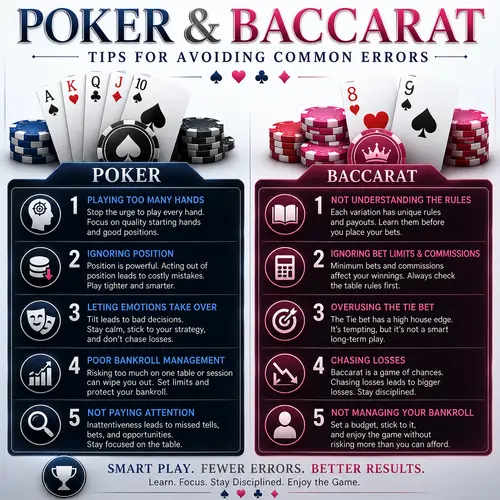
What Readers Should Know About Poker and Baccarat Tips for Avoiding Common Errors
Every casino player — whether at a felt table or a digital screen — walks into a game with a plan. But within a few rounds, emotion, noise, and losing streaks cloud judgment. That’s where Poker and Baccarat Tips for Avoiding Common Errors become your edge. These two games look very different on the surface. One is a skill-based battle of psychology; the other is a pure chance game with a simple bet structure. Yet the underlying mistakes — over-betting, misreading probabilities, and ignoring bankroll limits — are strikingly similar. For a related guide, see Poker and Baccarat Tips for Smarter Table Decisions.
By studying the most frequent errors in both games, you train yourself to recognize the same patterns in your own play. This article isolates nine specific mistakes — four for poker, four for baccarat, and one universal error — and gives you actionable fixes for each.
Poker Mistakes and How to Fix Them
1. Playing Too Many Hands from Early Position
The most common poker mistake new players make is entering pots with marginal hands from under the gun or in the blinds. Position is power in Texas Hold’em. When you act first, you give every opponent after you information they can use against you. Fix: Tighten your early-position range to high pairs, strong suited aces, and broadway cards. Fold everything else until you are in late position.
2. Bluffing Without a Story
A bluff that doesn’t make sense to a thinking opponent is a wasted bet. Poker mistakes in bluffing happen when you try to represent a hand that contradicts your betting pattern on earlier streets. Fix: Every bluff needs a credible narrative. If you check-call on the flop and then suddenly raise on the river, your opponent will call you down. Instead, bet or raise consistently on each street to sell your story.
3. Ignoring Pot Odds and Expected Value
Many players chase draws without calculating how much they must invest versus how much they can win. This is a fundamental poker mistake that drains chips over time. Fix: Memorize a simple pot odds table. When the pot offers you better than 4-to-1 on a flush draw, call. When the odds are worse, fold. Over a hundred hands, this math alone saves you dozens of big blinds.
4. Letting Tilt Ruin Your Decision-Making
One bad beat triggers another careless call, and soon you’ve lost a buy-in to ego-driven plays. Tilt is the most expensive non-technical error in the game. Fix: Set a hard rule — after a loss of 3 buy-ins, leave the table for 30 minutes. Walk away, breathe, and return with a clear head. Treat tilt management as seriously as hand selection.
Baccarat Mistakes and How to Avoid Them
1. Chasing Patterns on the Scoreboard
Baccarat tables display rows of Banker, Player, and Tie results. Players see “streaks” or “zigzags” and bet accordingly, believing past outcomes predict future ones. That is a classic baccarat mistake. Each hand is independent. Fix: Ignore the scoreboard entirely. Stick to betting on the Banker — it has the lowest house edge (1.06%) — and avoid Tie bets, which carry a 14.36% house edge.
2. Progressive Betting After Losses
Martingale-style systems promise to recover losses by doubling your bet after every losing round. In baccarat, this baccarat mistake is dangerous because table limits and bankroll size cap your progression. Fix: Use flat betting instead. Bet the same amount every hand. If your bankroll is $500, bet $10 per hand. Flat betting protects you from catastrophic runs that wipe out your session.
3. Betting on Tie Hands Too Often
The Tie bet pays 8-to-1 or 9-to-1, which looks tempting. But the true odds are much worse. This is one of the most costly baccarat mistakes players make. Fix: Treat Tie as a novelty bet only. If you must, allocate no more than 2% of your session bankroll to Tie wagers. Over time, the house edge will take its share.
4. Misunderstanding the Commission Rule
Winning Banker bets pay 1:1 minus a 5% commission. Players forget this commission when calculating their expected returns and think they are making even-money bets. Fix: Factor the commission into your session goal. If you bet $20 on Banker and win, you collect $19. Plan your cash-out target accordingly so you don’t think you have more than you actually do.
The Universal Error: Poor Bankroll Management
Whether you play poker or baccarat, one error crosses every game type: betting more than you can afford to lose or failing to separate playing money from real-life money. This is the single most important Poker and Baccarat Tips for Avoiding Common Errors. For a related guide, see Poker and Baccarat Tips for Understanding Game Rules.
Fix: Set a session bankroll cap before you sit down. For poker, bring no more than 10 buy-ins for the stakes you play. For baccarat, bring 30 units (e.g., $300 for a $10 minimum table). Once you lose your session cap, stop playing. Discipline with money is the foundation of all other strategies.
How to Apply These Tips During a Live Session
Knowing the Poker and Baccarat Tips for Avoiding Common Errors is one thing. Using them under pressure is another. Here is a three-step checklist to run before every session:
- Pre-game review (5 minutes): Remind yourself of the three biggest mistakes you made in your last session. Write them on your phone or a note card.
- In-game pause (after each 30 minutes): Stand up, stretch, and check your chip stack against your session cap. Ask yourself: “Am I playing my plan or my ego?”
- Post-game analysis (10 minutes): After you leave the table, note one decision you would change. Over a month, these notes will reveal patterns you can fix.
Applying this checklist transforms generic advice into personal discipline. Over time, you will catch yourself before you commit the same poker mistakes or baccarat mistakes again.
Useful Resources
For a deeper understanding of baccarat odds and house edge calculations, visit Wizard of Odds Baccarat Guide. This site breaks down every bet and commission rule with clear math.
To refine your poker hand-reading skills, study the strategies on PokerStrategy.com. Their free articles and videos cover position play, bluffing frequency, and bankroll management for all skill levels.
Disciplined players earn their edge not by outsmarting the game, but by outlasting the common errors that trip up everyone else. Use these Poker and Baccarat Tips for Avoiding Common Errors as your pre-session checklist, and you will walk away from the table with more chips — and more confidence — than you had before.
Frequently Asked Questions About Poker and Baccarat Tips for Avoiding Common Errors
What is the most common mistake poker players make?
The most common poker mistake is playing too many hands from early position, which puts you at a positional disadvantage and often leads to marginal decisions later in the hand.
What is the most common mistake baccarat players make?
The most common baccarat mistake is chasing patterns on the scoreboard instead of betting on the Banker, which has the lowest house edge at 1.06%.
Is baccarat purely luck or is there skill involved?
Baccarat is a game of pure chance. No card selection or strategy changes the outcome. The only skill involved is discipline — knowing which bets to avoid and when to stop.
Can you beat baccarat with a betting system?
No betting system can overcome the house edge in baccarat. Systems like Martingale increase risk without changing the underlying odds. Flat betting is the most sustainable approach.
What is the best bet in baccarat?
The Banker bet is the best, with a house edge of 1.06%. The Player bet has a slightly higher edge at 1.24%. Tie bets should be avoided due to their 14.36% house edge.
How many hands should I play per poker session?
Play around 60–100 hands per session in live poker, and stop earlier if you lose 3 buy-ins or feel yourself tilting. Quality matters more than quantity.
Should I always bluff in poker?
No. Bluffing is a strategic tool, not a requirement. Successful bluffs require a credible story, correct timing, and an opponent who can fold. Over-bluffing is a common poker mistake.
What is pot odds in poker?
Pot odds compare the current size of the pot to the cost of a call. If the pot is $100 and you must call $20, the pot odds are 5-to-1. Compare this to your hand’s drawing odds to decide whether to call.
How do I avoid tilt?
Set a hard rule to take a 30-minute break after losing 3 buy-ins. Deep breathing, walking, or discussing the hand with a friend can reset your emotional state and prevent tilt-based poker mistakes.
What is the 5% commission in baccarat?
When you bet on Banker and win, the casino keeps 5% of your winnings as commission. A $20 Banker win pays $19, not $20. Always factor this into your profit expectations.
Can I play baccarat without a scoreboard?
Yes. Many online baccarat tables offer a no-scores mode. Playing without the scoreboard helps you avoid pattern-chasing, one of the most costly baccarat mistakes.
What bankroll do I need for poker?
For cash games, bring at least 10 buy-ins for the stakes you play. For tournaments, bring at least 20 buy-ins to survive variance. Never play with money you cannot afford to lose.
What bankroll do I need for baccarat?
Bring 30 units. If the table minimum is $10, bring $300. This gives you enough hands to withstand variance while keeping losses within a manageable range.
What is the Tie bet payout?
Tie bets typically pay 8-to-1 or 9-to-1, but the true odds of a Tie are about 9.5-to-1. The difference creates a house edge of 14.36%. Avoid this bet for long-term play.
Should I play baccarat online or live?
Both are fine for learning Poker and Baccarat Tips for Avoiding Common Errors. Online offers lower minimums and faster play; live gives you a social atmosphere and slower pace for decision-making.
What is the difference between Punto Banco and Chemin de Fer?
Punto Banco is the most common version. The casino banks the game, and players have no decisions on drawing cards. Chemin de Fer allows players to act as the banker and choose whether to draw. Most modern casinos use Punto Banco.
How do I know if I am making poker mistakes ?
Track your sessions. Note your starting hands, wins, losses, and any tilt triggers. Reviewing your own data reveals recurring poker mistakes you can correct over time.
What is the safest strategy for baccarat beginners?
Bet only on Banker, use flat betting, ignore the scoreboard, and cap your session at 30 units. This simple approach minimizes baccarat mistakes and keeps your session under control.
How long does a poker session last?
Live poker sessions average 2–4 hours. Online sessions can be shorter. Stop when you lose 3 buy-ins, feel tired, or notice your decision quality dropping.
Can I combine poker and baccarat tips in one session?
Yes. The universal Poker and Baccarat Tips for Avoiding Common Errors — bankroll discipline, emotional control, and bet sizing — apply to both games and can be used across a single casino visit.